Dow Plunges 848 Points as AI Valuation Anxiety Grips Wall Street
Wall Street suffered a severe selloff as the Dow dropped 848 points, triggered by heightened anxiety over artificial intelligence valuations, elevated bond yields, and new federal chip export limits.
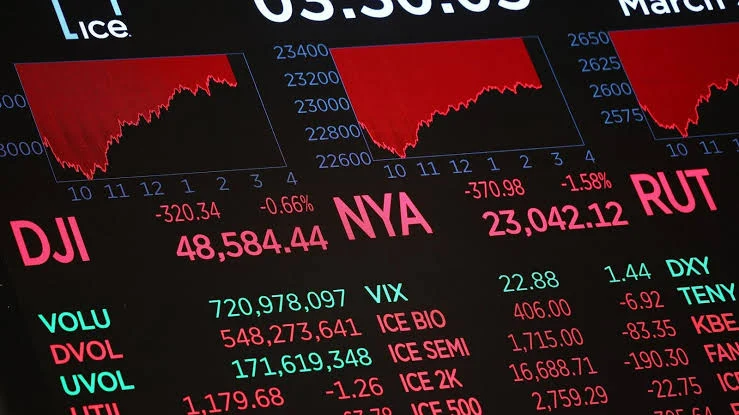
- Dow Jones sinks 848.75 points to 50,759.42 amid tech selloff and 10-year Treasury yields topping 5%.
- Nvidia faces intense market scrutiny ahead of first earnings report since Jensen Huang's unexpected exit.
- U.S. Commerce Department imposes strict new licensing rules on foreign remote access to AI cloud compute.
NEW YORK — A wave of intense institutional selling swept across Wall Street on Tuesday and Wednesday, driving the Dow Jones Industrial Average down by 848.75 points to close at 50,759.42 in one of the sharpest single-day declines of the quarter. The dramatic downturn was mirrored across broader indices, with the benchmark S&P 500 falling 1.0% to 7,340.53 and the tech-heavy Nasdaq Composite retreating 0.7% to 24,328.38, as investors grappled with a convergence of elevated sovereign bond yields, new international export controls, and nerve-racking uncertainty surrounding artificial intelligence capital expenditure returns.
At the epicenter of market trepidation was semiconductor giant Nvidia, which faced heightened scrutiny ahead of its highly anticipated quarterly financial earnings release—the first official earnings report since the abrupt departure of founding chief executive Jensen Huang earlier this month. The sudden leadership vacuum, coupled with astronomical expectations baked into megacap technology valuations, triggered widespread de-risking among quantitative funds and institutional asset managers. Across trading floors, fund managers moved swiftly to trim exposure to high-multiple semiconductor and enterprise software stocks that have powered the equity bull market for over two years.
Market jitters were amplified significantly by an announcement from the U.S. Department of Commerce unveiling stringent new regulatory rules governing remote access to advanced computing infrastructure. Under the new export restrictions, cloud providers and data center operators worldwide will be required to obtain federal licenses before providing high-performance computing power to foreign entities based in restricted jurisdictions, including China. The mandate, which imposes a strict 90-day compliance timeline, sparked immediate fears of revenue headwinds for domestic cloud infrastructure leaders and hyperscaler data center developers.
Macroeconomic crosscurrents added further pressure to equity valuations. The 10-year U.S. Treasury yield climbed past 5.02%, reflecting persistent investor anxiety over sticky services inflation and the Federal Reserve's signaled reluctance to ease borrowing costs prematurely. Fresh retail sales data showed consumer spending grew at a modest 0.2% in October, coming in slightly under consensus estimates and underscoring concerns that prolonged high interest rates are beginning to weigh on middle-income household budgets despite resilient labor market metrics.
"What we witnessed today was a necessary reality check for a market priced for absolute perfection," said Marcus Thorne, chief global strategist at Manhattan Asset Management. "For nearly twenty-four months, investors have treated every generative AI headline as an unassailable license to bid up multiples. But when you combine a 5% risk-free rate, sweeping federal regulatory hurdles on global chip distribution, and leadership transitions at foundational companies, capital demands tangible revenue proof over speculative narrative."
Despite the steep selloff, corporate bond markets remained orderly, and commodity prices softened, with West Texas Intermediate crude settling below $88 a barrel. Nonetheless, trading desks are bracing for continued volatility as derivative markets price in outsized swings following Nvidia's post-closing bell figures and the upcoming release of the Federal Open Market Committee's policy minutes.
Congressional testimony scheduled for later this month is expected to address cross-agency coordination, focusing specifically on supply chain resiliency, sovereign compute clusters, and long-term capital allocation strategies designed to safeguard domestic competitiveness.