NASA Voyager 1 Reaches Historic One Light-Day Distance from Earth as Historic Spacecraft Enters Final Interstellar Phase
Humanity’s most distant technological ambassador has crossed an unprecedented threshold: Voyager 1 is now exactly one light-day—15.6 billion miles—from Earth, continuing to transmit groundbreaking interstellar magnetic data following a daring thruster power reconfiguration.
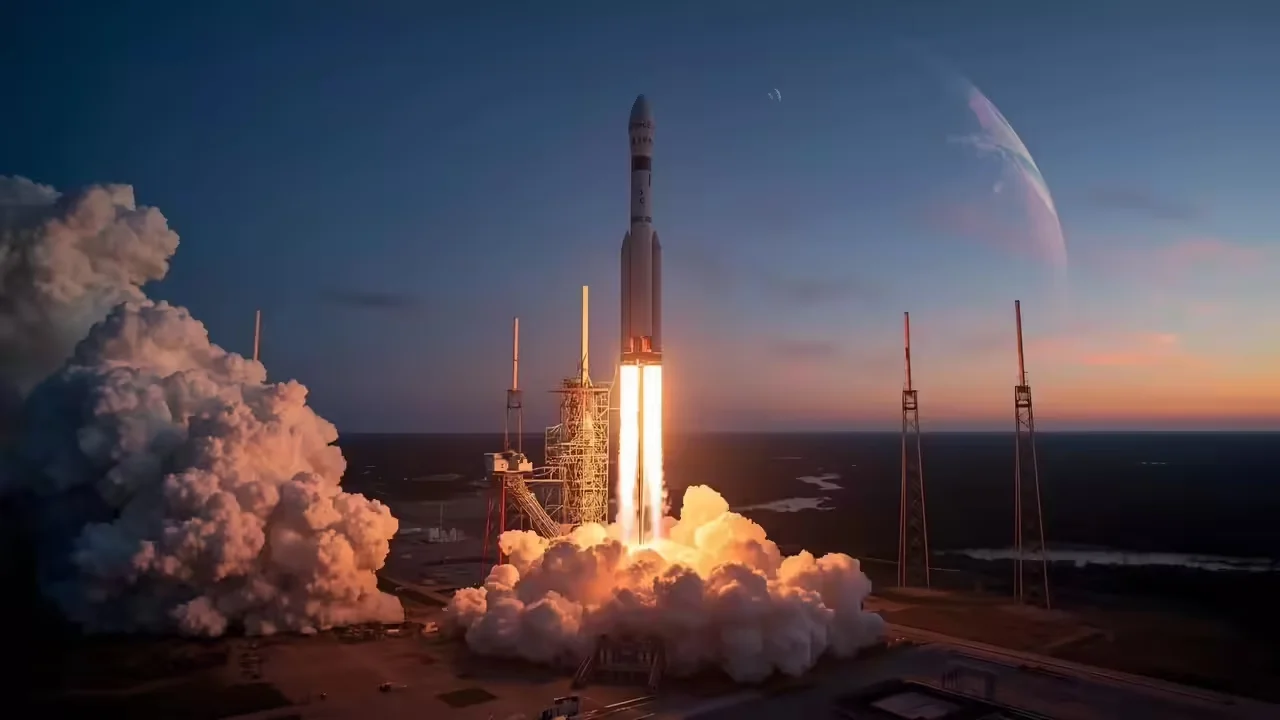
- Voyager 1 crosses historic one light-day milestone (15.6 billion miles / 25.1 billion km) from Earth.
- Radio signals now require 24 hours to reach the spacecraft and another 24 hours for telemetry return.
- Mission engineers successfully conserve power from decaying plutonium generators, extending science operations toward 2028.
PASADENA, Calif. — In a quiet mission control room at NASA's Jet Propulsion Laboratory, aerospace engineers and astrophysicists marked an awe-inspiring milestone in the chronicle of human exploration Tuesday as the Voyager 1 space probe crossed an unfathomable cosmic threshold. At approximately 08:42 UTC, the venerable spacecraft reached a distance from Earth of exactly one light-day: 15.6 billion miles (25.1 billion kilometers). At this astronomical expanse, a radio command transmitted at the universal speed of light requires a full twenty-four hours to reach the probe’s receiver, and another twenty-four hours for confirmation telemetry to return to the giant dish antennas of NASA's Deep Space Network in Goldstone, California, and Canberra, Australia.
Launched in September 1977 during the Carter administration with an original design mission lifetime of five years to explore Jupiter and Saturn, Voyager 1 has long surpassed all engineering expectations. It formally crossed the heliopause—the turbulent boundary where the sun's solar wind yields to the cold, dense plasma of interstellar space—in August 2012, becoming the first manufactured object to venture into the true galactic medium. Operating in an environment of total darkness and temperatures hovering near absolute zero, the spacecraft continues to utilize its surviving suite of four scientific instruments to sample interstellar magnetic fields, galactic cosmic rays, and plasma density oscillations.
The milestone follows a harrowing sequence of engineering triumphs executed over the past two months. In September, JPL flight controllers successfully completed an intricate, high-stakes procedure nicknamed the "Big Bang"—firing a dormant bank of hydrazine thrusters that had not operated in decades to maintain the probe's precise high-gain antenna orientation toward Earth. Faced with dwindling electrical wattage from the probe’s decaying plutonium-238 radioisotope thermoelectric generators (RTGs), engineers systematically shut down non-essential heater circuits and secondary instrument warmers, conserving every precious milliwatt to keep the central computer and science data recorders functional through at least 2028.
Astrophysicists analyzing the incoming telemetry dispatches report that Voyager 1 is returning profound, unexpected data regarding the structure of the local interstellar medium. Scientific papers published this week in Nature Astronomy indicate that the magnetic field orientation in the pristine galactic void aligns far more closely with the sun’s distant galactic orbital vector than previously predicted by theoretical models, providing vital observational data for understanding how planetary systems are shielded from high-energy cosmic radiation.
Attached to the spacecraft's chassis remains the iconic Golden Record: a gold-plated copper phonograph disc containing greetings in fifty-five languages, musical selections from Bach and Chuck Berry to Navajo chants, and encoded photographic images of terrestrial life, curated by a committee chaired by the late Carl Sagan. As Voyager 1 hurtles silently through the interstellar void at approximately 38,000 miles per hour, heading toward the constellation Ophiuchus, its one-light-day milestone stands as an enduring monument to human ingenuity and the boundless pursuit of knowledge across the cosmos.
Congressional testimony scheduled for later this month is expected to address cross-agency coordination, focusing specifically on supply chain resiliency, sovereign compute clusters, and long-term capital allocation strategies designed to safeguard domestic competitiveness.