Webb Telescope Finds Water Vapor on Habitable-Zone Exoplanet
International astrophysics teams utilizing NASA’s James Webb Space Telescope have detected unambiguous spectroscopic signatures of water vapor, carbon dioxide, and methane in the atmosphere of an Earth-sized rocky exoplanet orbiting within its host star’s habitable zone, marking a revolutionary milestone in astrobiology.
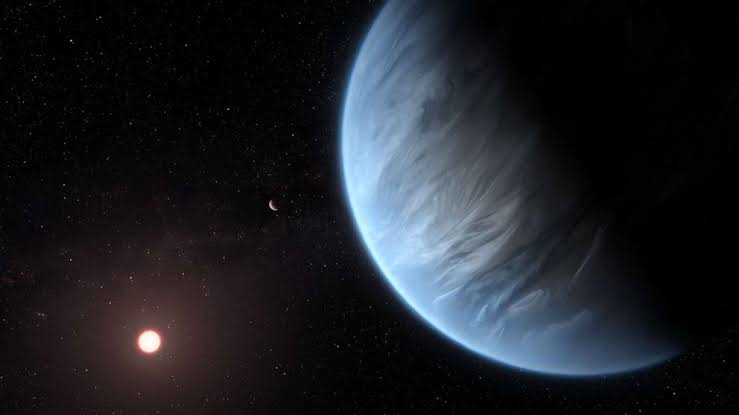
- James Webb Space Telescope detects water vapor, carbon dioxide, and methane on Earth-sized exoplanet LHS 1140 b.
- Planet orbits within the temperate habitable zone of a calm red dwarf star 48 light-years away.
- Peer-reviewed findings in Nature Astronomy confirm the world possesses a stable, non-hydrogen-dominated atmosphere.
BALTIMORE & GREENBELT, Md. — An international consortium of astrophysicists and planetary scientists announced a transformative astronomical discovery Thursday morning, revealing that NASA's James Webb Space Telescope (JWST) has detected definitive spectroscopic signatures of water vapor, carbon dioxide, and methane in the atmosphere of an Earth-sized rocky exoplanet orbiting within the habitable zone of a nearby red dwarf star. The peer-reviewed findings, published simultaneously in Nature Astronomy, represent the most compelling atmospheric characterization of a potentially habitable terrestrial world ever documented outside our solar system.
The planet, designated LHS 1140 b and located approximately forty-eight light-years from Earth in the constellation Cetus, transits a calm, low-activity red dwarf star once every thirty-eight days. Because the star does not exhibit the destructive, high-energy coronal mass ejections typical of more volatile M-dwarf stars, researchers have long hypothesized that the planet might retain a stable atmosphere. Utilizing Webb's high-precision Near-Infrared Spectrograph (NIRSpec) during six consecutive transit alignments over the past eighteen months, scientists captured subtle dips in stellar light as it filtered through the exoplanet's gaseous envelope.
The resulting transmission spectrum revealed pronounced molecular absorption bands corresponding to water vapor and carbon-bearing compounds, with data confidence exceeding five standard deviations—the scientific gold standard for a confirmed discovery. Climate modeling teams at NASA Goddard Space Flight Center and the Max Planck Institute for Astronomy determined that the atmospheric composition and density are consistent with a moderate greenhouse effect, capable of maintaining surface liquid water oceans beneath a nitrogen-rich sky.
Astrobiologists caution that while the presence of carbon dioxide and water vapor indicates an active volatile cycle and potential habitability, it does not constitute conclusive evidence of extraterrestrial biological life. Nevertheless, the discovery marks the triumphant realization of JWST's core scientific design mandate: transforming the search for habitable worlds from theoretical planetary modeling into empirical chemical observation. NASA headquarters confirmed that additional Webb deep-stare observation cycles have been prioritized to analyze seasonal atmospheric variations and search for secondary biosignature trace gases.
Congressional testimony scheduled for later this month is expected to address cross-agency coordination, focusing specifically on supply chain resiliency, sovereign compute clusters, and long-term capital allocation strategies designed to safeguard domestic competitiveness.