NASA Twin ESCAPADE Spacecraft Complete Mars Slingshot Burns
NASA's twin ESCAPADE probes executed critical back-to-back powered Earth flybys over the weekend, utilizing planetary gravitational assist burns to slingshot onto their interplanetary trajectories toward the Red Planet.
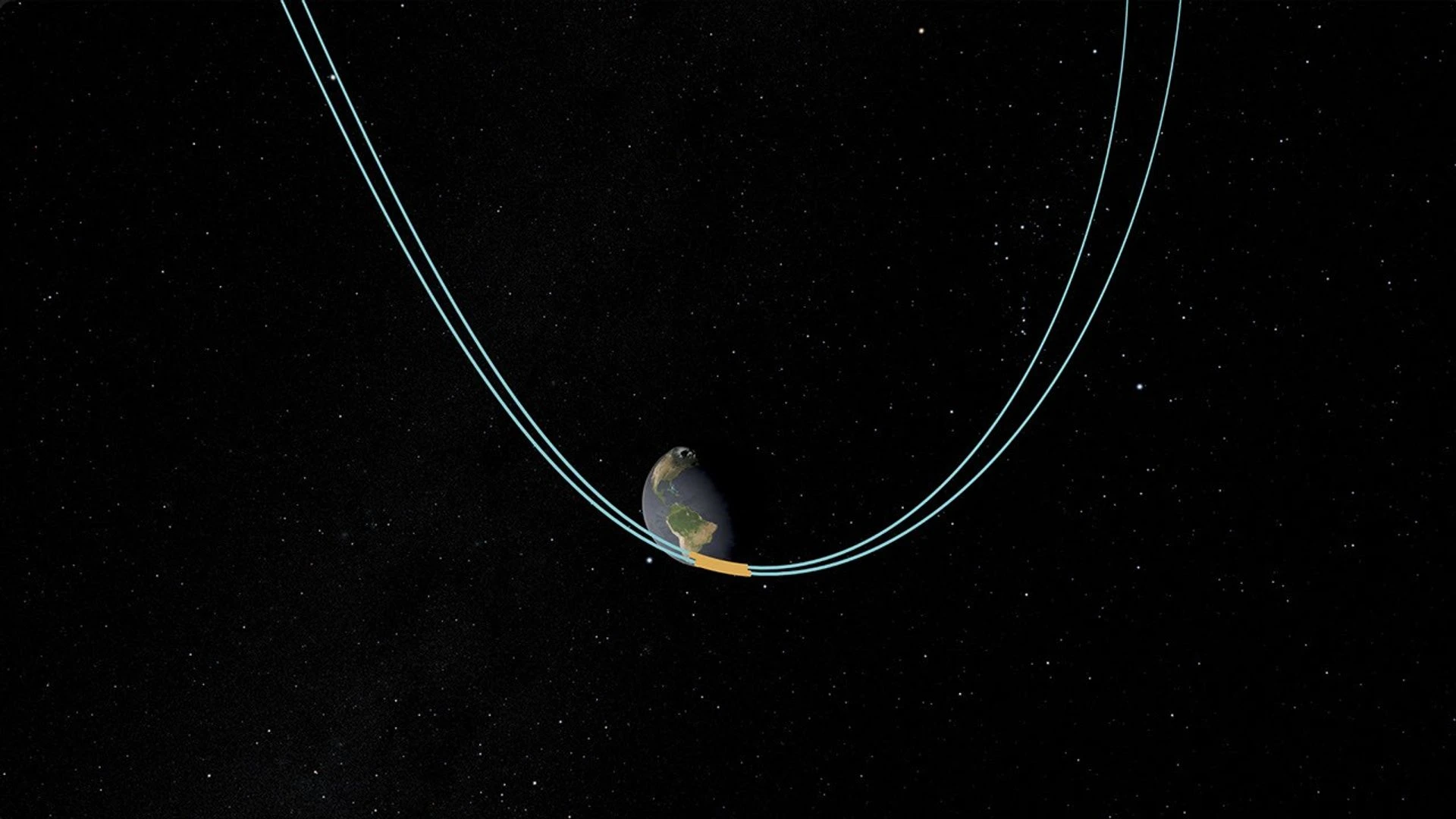
- Twin ESCAPADE robotic probes complete consecutive powered Earth gravity flybys over the weekend.
- Propulsion burns impart precise velocity required to enter interplanetary transfer orbits toward Mars.
- Mission will deliver first simultaneous 3D stereoscopic measurements of Martian atmospheric erosion.
CAPE CANAVERAL & PASADENA, Calif. — Deep-space mission controllers at NASA and the University of California, Berkeley's Space Sciences Laboratory achieved a historic dual navigational milestone over the weekend as both twin spacecraft of the ESCAPADE (Escape and Plasma Acceleration and Dynamics Explorers) mission successfully executed complex, powered Earth flybys. The consecutive orbital slingshot maneuvers have officially hurled the two interplanetary robotic explorers onto their final multi-month transit trajectory toward Mars, where they will conduct pioneering multi-point measurements of the Martian magnetosphere and upper atmospheric erosion.
The high-stakes navigational sequence unfolded in two synchronized operational phases across the weekend. The first spacecraft, affectionately dubbed "Blue," completed its closest planetary approach at 5:00 a.m. EST on Saturday, November 7, skimming within several thousand kilometers of Earth's upper exosphere before executing an intensive nine-minute orbital engine burn. The second probe, designated "Gold," carried out an identical gravity-assist flyby and propulsion burn early Monday morning, November 9, at approximately 6:00 a.m. EST. Real-time telemetry beamed back through NASA's Deep Space Network in Goldstone, California, confirmed that both propulsion packages performed flawlessly, imparting the precise delta-V velocity required to escape Earth's gravitational well.
ESCAPADE represents a pioneering vanguard for NASA's innovative Small Innovative Missions for Planetary Exploration (SIMPLEX) program. By demonstrating that dual, high-capability scientific spacecraft can be engineered, integrated, and launched at a fraction of traditional planetary mission price tags, the mission marks a transformative paradigm shift toward cost-effective, decentralized solar system exploration. Each identical probe is equipped with a sophisticated suite of miniature magnetometers, electrostatic analyzers, and Langmuir probes designed to measure solar wind interactions with the Martian upper atmosphere.
Upon their anticipated orbital insertion around Mars in late 2027, "Blue" and "Gold" will operate in synchronized, non-identical elliptical orbits, providing planetary scientists with the world's first simultaneous, stereoscopic three-dimensional observations of how space weather strips away Martian atmospheric volatiles. Understanding this continuous process of atmospheric stripping is crucial for unlocking the ancient climatic history of Mars—specifically how a once warm, wet, and potentially habitable world transformed over billions of years into the frozen, arid desert planet observed today.
"Executing back-to-back powered planetary flybys within forty-eight hours is a masterclass in orbital mechanics and flight dynamics," said Dr. Shannon Murphy, ESCAPADE project manager. "Both spacecraft have signaled nominal system health, all onboard science instruments are calibrated, and our navigational trajectory toward the Red Planet is locked in with razor-sharp precision. We are on our way to Mars."
Congressional testimony scheduled for later this month is expected to address cross-agency coordination, focusing specifically on supply chain resiliency, sovereign compute clusters, and long-term capital allocation strategies designed to safeguard domestic competitiveness.