NASA Completes Dragonfly Titan Camera Integration as ESA’s Euclid Telescope Discovers First Comet and Record Quasar
NASA engineers completed installation and testing of all seven science cameras aboard the nuclear-powered Dragonfly rotorcraft bound for Saturn’s moon Titan, coinciding with breakthrough comet and early-universe quasar discoveries by Europe’s Euclid telescope.
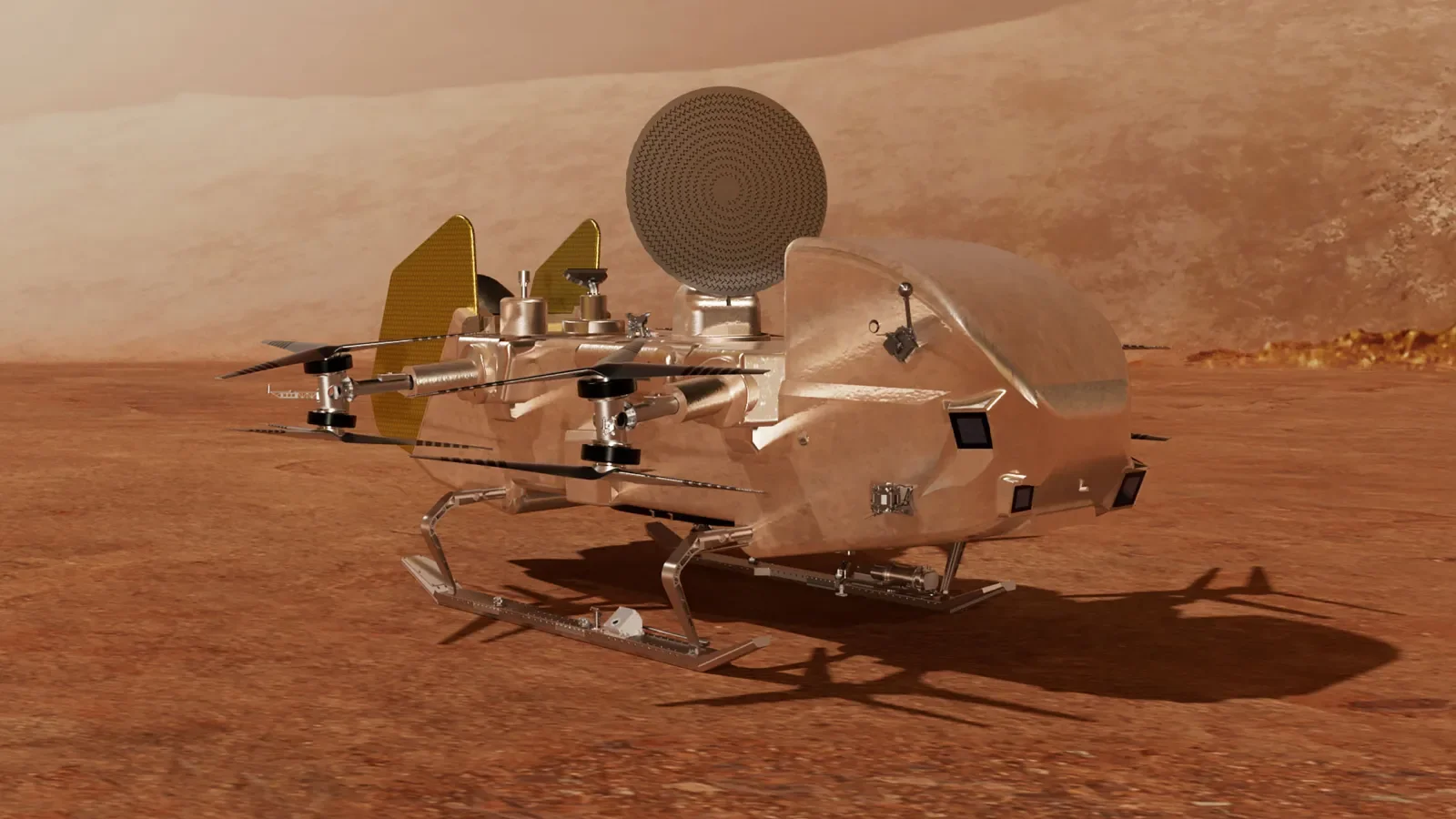
- NASA announced that all seven science cameras for the Titan-bound Dragonfly rotorcraft have been integrated and tested at Johns Hopkins Applied Physics Laboratory.
- The European Space Agency's Euclid space telescope discovered its first comet alongside a cosmic-distance record quasar formed roughly 650 million years after the Big Bang.
- Separately, planetary geophysicists traced a high-quality InSight marsquake to Mars's Valles Marineris canyon, pointing to an unexpectedly active fault zone.
In a landmark week for planetary engineering and deep-space astronomy, NASA confirmed that engineers at the Johns Hopkins Applied Physics Laboratory (APL) have successfully installed, calibrated, and tested all seven science cameras aboard the Dragonfly rotorcraft—clearing a vital hardware integration milestone for humanity’s first nuclear-powered flying laboratory bound for Saturn’s giant moon Titan.
Scheduled to soar through Titan’s dense, nitrogen-rich atmosphere and examine prebiotic organic chemistry across towering hydrocarbon sand dunes and frozen impact craters, Dragonfly’s multi-camera optical suite serves both as autonomous hazard-avoidance eyes during flights and as microscopic geological imagers capable of resolving sand grains on the surface of an alien ocean world.
Eyes Ready for an Alien Methane World
Equipped with specialized panoramic, downward-facing, and microscopic lenses designed to function in cryogenic temperatures near minus 290 degrees Fahrenheit, the Dragonfly camera suite underwent rigorous thermal-vacuum and optical alignment testing inside APL’s cleanrooms in Laurel, Maryland.
"Integrating all seven flight-qualified science cameras marks a defining step from blueprint to flight-ready spacecraft," Dragonfly engineering leads reported this week. "Titan hosts the only other dense atmosphere and liquid surface cycle in our solar system besides Earth. These optics will allow planetary scientists to map organic chemistry across dozens of landing sites in unprecedented detail."
Meanwhile, complementary NASA InSight seismic research published this week reshaped scientific views of Martian geology: researchers traced one of the mission’s strongest recorded tremors—marsquake S0976a—directly to the colossal Valles Marineris canyon system, revealing evidence of an active tectonic fault zone on a planet long assumed geologically dormant.
ESA’s Euclid Logs First Comet and Record Cosmic Quasar
Across the Atlantic, scientists operating the European Space Agency’s (ESA) Euclid space telescope celebrated an extraordinary double-discovery milestone demonstrating the observatory's wide-field sensitivity beyond its core mission of mapping dark matter and dark energy.
First, astronomers announced Tuesday that Euclid set a new cosmic distance record by detecting Dún Aonghasa, an ancient luminous quasar powered by a colossal black hole observed when the universe was roughly 630 to 662 million years old—shining unprecedented light on how supermassive black holes assembled astonishingly fast right after Cosmic Dawn.
Hours later, ESA researchers revealed that while combing through deep-sky survey frames captured earlier this autumn, Euclid unexpectedly spotted its very first previously unknown comet—an icy deep-space wanderer traveling on an extreme orbital trajectory spanning thousands of years across the outer solar system.
Congressional testimony scheduled for later this month is expected to address cross-agency coordination, focusing specifically on supply chain resiliency, sovereign compute clusters, and long-term capital allocation strategies designed to safeguard domestic competitiveness.