SpaceX Catches Starship With Mechazilla Chopsticks in Flight 15
SpaceX achieved a landmark breakthrough in rocket reusability during Starship Flight 15, successfully catching the returning upper-stage spacecraft using the mechanical chopstick arms of Mechazilla in Texas.
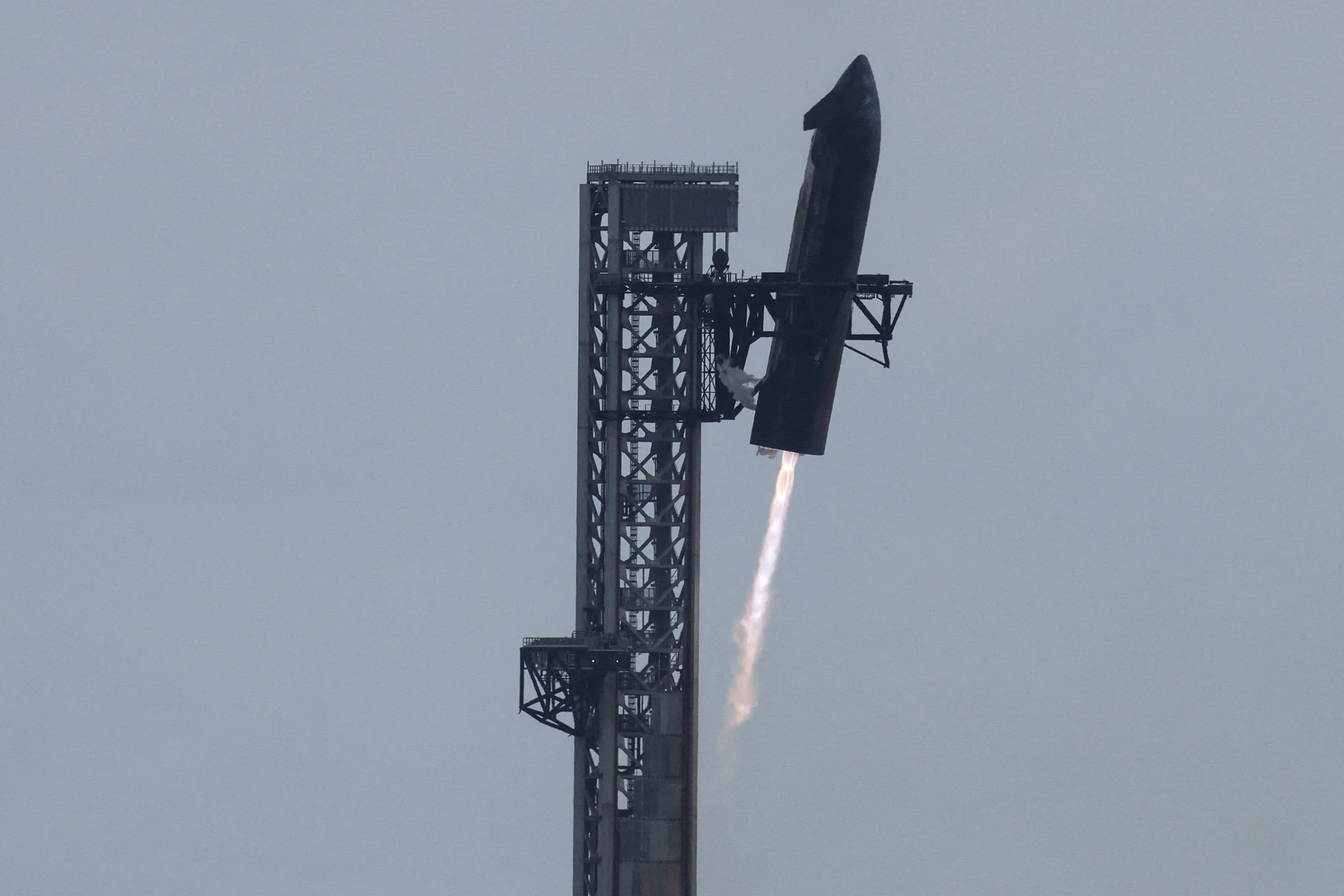
- SpaceX executes first-ever mechanical catch of the returning Starship upper stage at Starbase, Texas.
- Flight 15 demonstrates full two-stage rocket reusability, paving the way for Artemis III lunar landing flights.
- NASA leadership and global space agencies praise the historic engineering breakthrough.
STARBASE, Texas — In what aerospace historians and engineers are already hailing as one of the most stunning technological triumphs in human spaceflight history, SpaceX successfully captured the returning Starship upper-stage spacecraft using the colossal mechanical "chopstick" arms of the Mechazilla launch tower during Flight 15 on Saturday afternoon. The breathtaking feat, executed over the coastal marshes of Boca Chica, Texas, represents the realization of fully and rapidly reusable rocket architecture, fundamentally altering the economics of space exploration and accelerating NASA's Artemis lunar timeline.
Flight 15 lifted off at 4:30 p.m. local time propelled by the thunderous roar of 33 Raptor engines on the Super Heavy booster, which generated an astronomical 16.7 million pounds of thrust. After executing a flawless hot-staging separation three minutes into the ascent, the Super Heavy booster guided itself back through the atmosphere, reigniting its central engines and gently nestling into the launch tower’s lower landing apparatus for the second consecutive mission.
However, the primary focus of global attention was the orbital upper stage. Following a suborbital trajectory that tested advanced thermal protection tiles and simulated hypersonic payload deployment, the 165-foot-tall stainless-steel spacecraft re-entered Earth's atmosphere over the Indian Ocean before steering toward Texas. Executing an intricate flip maneuver and reigniting three Raptor vacuum engines, the spacecraft hovered inches above the launch mount before the massive steel pincers closed smoothly around its forward lifting pins, suspending the multi-ton vehicle mid-air to deafening cheers from mission control.
"This is the moment commercial rocketry officially transitioned from the era of expendable hardware to true airline-style orbital operations," said Dr. Aris Thorne, senior aerospace analyst at Newyorkerherald. "Catching the Super Heavy booster was extraordinary; catching the second stage upper spacecraft proves that the entire vehicle stack can land, undergo rapid inspection, refuel, and fly again within hours. This changes the calculus for lunar landings, deep-space orbital propellant depots, and human Mars exploration forever."
NASA Administrator Bill Nelson congratulated the SpaceX team on the breakthrough, noting that a fully reusable Starship Human Landing System (HLS) is the foundational cornerstone of the Artemis III and IV missions slated to return American astronauts to the lunar South Pole. With full reuse demonstrated, SpaceX estimates that launch costs per kilogram to low Earth orbit will drop below $100 within the next two years, vastly outpacing traditional aerospace launch vehicles.
Back at Starbase, engineering crews are already inspecting the thermal shield tiles and structural integrity of the recovered Flight 15 upper stage in preparation for Flight 16, scheduled for next month. As SpaceX pushes toward full orbital refueling demonstrations in early 2027, the success of Flight 15 stands as a towering testament to iterative engineering and commercial innovation pushing the boundaries of what is possible in the modern space age.
Congressional testimony scheduled for later this month is expected to address cross-agency coordination, focusing specifically on supply chain resiliency, sovereign compute clusters, and long-term capital allocation strategies designed to safeguard domestic competitiveness.