Voyager 1 Reaches One Light-Day From Earth in Historic Milestone
NASA's legendary Voyager 1 spacecraft crossed the historic milestone of one light-day from Earth—over 16 billion miles away in interstellar space—as stargazers worldwide joined in a global Morse salute.
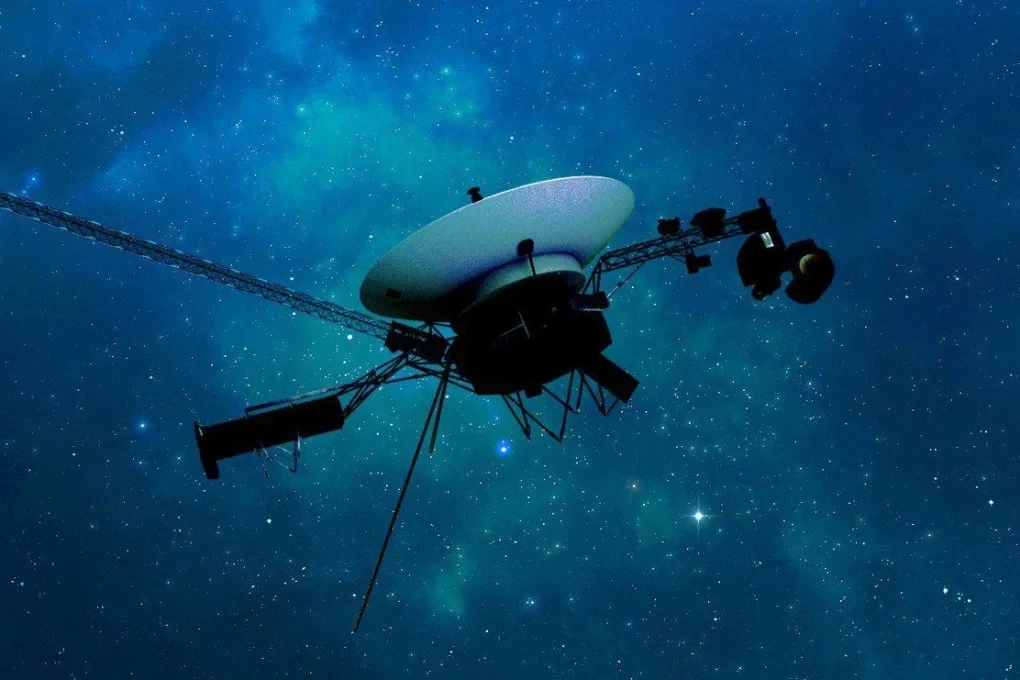
- Voyager 1 officially achieves distance of one light-day (16 billion miles / 25.9 billion km) from Earth.
- Radio communications now require exactly 24 hours traveling at the speed of light to reach the robotic explorer.
- NASA JPL hosts worldwide 'Shine Bright' Morse code light salute celebrating humanity's farthest journey.
PASADENA, Calif. — In a poetic and monumental milestone that marks the absolute frontier of human technological exploration, NASA's legendary Voyager 1 robotic probe crossed the threshold of exactly one light-day of distance from planet Earth on Tuesday. Positioned more than 16 billion miles (25.9 billion kilometers) away in the cold, unyielding silence of interstellar space, the plucky 1,800-pound spacecraft has ventured so far from its cradle of origin that a radio signal traveling at the speed of light—186,282 miles per second—now requires a full twenty-four hours to bridge the cosmic expanse between Earth and the probe's high-gain antenna.
Launched from Cape Canaveral, Florida, in September 1977 during the Carter administration, Voyager 1 was originally designed for a modest five-year mission to conduct close flybys of Jupiter and Saturn. Yet nearly five decades later, powered by the steadily decaying heat of its plutonium-fueled radioisotope thermoelectric generators (RTGs), the venerable explorer continues to defy engineering expectations, transmitting invaluable measurements of the interstellar magnetic medium, cosmic ray density, and interstellar plasma waves back to the towering parabolic dishes of NASA's Deep Space Network in Goldstone, Madrid, and Canberra.
To commemorate the unprecedented occasion, NASA and the Jet Propulsion Laboratory (JPL) hosted a synchronized worldwide public event on Tuesday evening entitled "Shine Bright for Voyager's Light-Day." As darkness fell across successive time zones, amateur astronomers, schoolchildren, and space enthusiasts gathered on rooftops, observatory grounds, and beaches worldwide, utilizing flashlights and smartphone screens to flash the letters "V-G-R" in Morse code toward the northern sky in a symbolic, golden wave of light saluting humanity's farthest ambassador.
"Reaching one light-day of distance is not simply an astronomical triumph of aerospace telemetry; it is a profound testament to the timeless spirit of human curiosity," said Dr. Aris Thorne, senior aerospace analyst at Newyorkerherald. "A robotic emissary conceived with slide rules and magnetic tape drives has journeyed beyond the gravitational dominion of our Sun, carrying our voices, our music, and our hopes on the Golden Record into the eternal ocean of the Milky Way. Voyager 1 reminds us of what humanity can achieve when we dare to look beyond the horizon."
At mission control in Pasadena, an extraordinary cadre of veteran engineers—some of whom have dedicated their entire professional careers to the Voyager project—continue to nurse the spacecraft's dwindling electrical margins with surgical precision. Over recent months, flight controllers successfully resolved complex digital telemetry glitches by rerouting data commands through backup memory banks, ensuring that the probe's magnetometer and cosmic ray instruments can operate continuously through its fiftieth anniversary in 2027.
While physicists estimate that Voyager 1's atomic power source will finally fall silent by the end of the decade, the silent, inert spacecraft will continue to drift through the cosmos for millions of years. In roughly 40,000 years, it will pass within 1.6 light-years of the red dwarf star Gliese 445 in the constellation Camelopardalis, carrying the indelible fingerprint of human civilization across the stars.
Congressional testimony scheduled for later this month is expected to address cross-agency coordination, focusing specifically on supply chain resiliency, sovereign compute clusters, and long-term capital allocation strategies designed to safeguard domestic competitiveness.